OpenAI Unveils Jalapeño, Its First Custom AI Chip

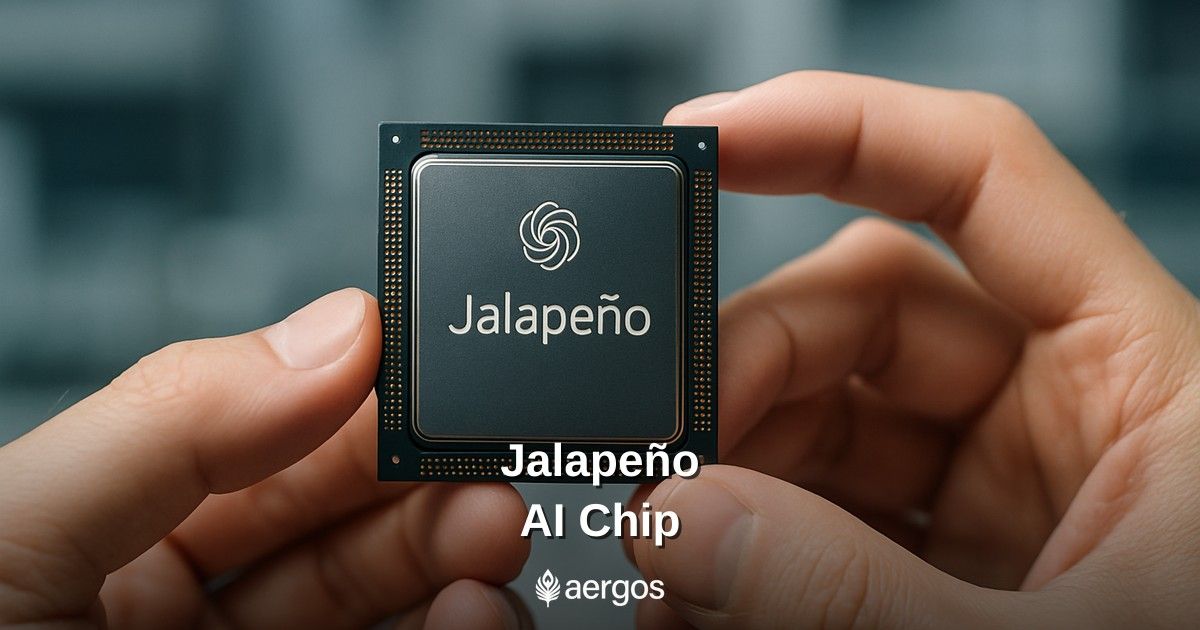
OpenAI dropped a significant piece of hardware news on Wednesday, June 24, 2026: the company revealed Jalapeño, its first custom AI processor, built in partnership with Broadcom. According to OpenAI reveals its first AI processor: Jalapeño, the chip is an ASIC — an Application-Specific Integrated Circuit — designed specifically for AI inference, the process that powers every ChatGPT response and Codex agent interaction you and your users experience daily.
This announcement comes just nine months after OpenAI first revealed its plan to co-develop chips with Broadcom — a move aimed squarely at reducing the company's dependence on Nvidia's GPUs, which have been in notoriously short supply. OpenAI is calling Jalapeño the "first step in a multi-generation compute platform" and expects to deploy it by the end of 2026.
The Details: What Jalapeño Actually Is
Jalapeño is not a general-purpose chip. It is purpose-built for one job: AI inference. That distinction matters. Inference is what happens when a model takes your prompt and generates a response. Training — the other half of AI compute — is a separate, massively intensive process that still relies on different hardware. Jalapeño handles the former: the real-time, user-facing side of running AI at scale.
According to The Verge's reporting, Broadcom CEO Hock Tan stated in an interview with Reuters that Jalapeño matches the performance of Nvidia's Blackwell chips and Google's Tensor Processing Units. That is a bold claim — and OpenAI itself is hedging slightly, noting that "early testing shows that Jalapeño will deliver performance per watt substantially better than current state-of-the-art," while adding that final performance is still being measured.
OpenAI is not the first tech giant to go down this road. Microsoft, Meta, and Amazon have all launched custom-designed AI chips recently to power their own inference and training infrastructure. Even so, The Verge notes that all of these custom chips still trail Nvidia's overall performance. The Nvidia advantage is real — but the gap is clearly narrowing.
Why It Matters for SEO and AI Search
You might be wondering: why does a chip announcement matter to someone running SEO for a brand or an agency? Fair question. Here is the short answer — AI inference infrastructure is the engine behind every AI Overview, every Perplexity answer, every ChatGPT citation. The faster and cheaper that engine gets, the more AI-generated answers flood the top of search results. And that changes everything about how your content needs to be structured.
When OpenAI reduces its inference costs by deploying more efficient hardware, it can serve more queries, run more agents, and expand features like Codex and ChatGPT into more surfaces. More AI-generated responses means more competition for the organic clicks you are currently counting on. This is not a hypothetical — it is the trend that has been playing out in search since AI Overviews launched in Google Search, and Jalapeño accelerates the timeline.
Think about it from a content strategy angle. If inference gets dramatically cheaper and faster, the volume of AI-answered queries goes up. The brands that get cited inside those AI answers are the ones doing the work now to build genuine authority: clean structured data, strong E-E-A-T signals, and content that actually answers questions at a depth that AI models want to surface. That window to get ahead is not staying open indefinitely.
There is also a competitive-intelligence angle here. Every major player — Microsoft, Meta, Amazon, Google — is racing to control their own inference stack. That means each AI search product (Copilot, Perplexity, ChatGPT, Gemini) will increasingly run on proprietary hardware tuned for their own models. The ranking signals inside those systems will diverge. If you are only optimizing for one AI surface right now, you are already behind.
What to Do Now
News like this is a good forcing function. Use it. Here are the concrete moves worth making right now in response to a world where AI inference is getting faster, cheaper, and more pervasive.
- Audit your AI visibility today. Find out where you are — and are not — being cited in ChatGPT, Perplexity, and Google AI Overviews. You cannot optimize what you have not measured. AI visibility checker tools make this a lot less painful than it used to be.
- Tighten your structured data. ASICs like Jalapeño are built to process inference at scale. The models running on them still depend on well-structured, clearly attributed content to cite with confidence. Schema markup, clean HTML, and clear authorship are not optional extras — they are table stakes for AI citations.
- Stop treating AI search as one channel. Microsoft's Copilot, OpenAI's ChatGPT, Google's Gemini, and Perplexity are all building on different hardware stacks and tuning their own models. Your content strategy needs breadth, not just Google-first thinking.
- Build content depth, not just coverage. Inference engines surface content that fully answers a query. Thin, keyword-stuffed pages get skipped. Long-form, well-sourced content with genuine expertise is what gets pulled into AI-generated answers.
- Watch the deployment timeline. OpenAI says it expects to deploy Jalapeño by the end of 2026. That is your rough benchmark for when ChatGPT's inference capacity could scale significantly. Plan your content calendar around it.
Background and Context
The chip race in AI is not new, but it is accelerating. Nvidia built an early and commanding lead on AI training hardware, and that advantage carried over into inference. But the economics of running large language models at scale are brutal — GPU costs are a massive line item for every AI company. Custom ASICs are the industry's answer to that problem.
Google has had its Tensor Processing Units for years. Amazon has Trainium and Inferentia. Meta has its own inference chips. Microsoft has been investing in custom silicon too. The Verge places Jalapeño squarely inside this broader "chip race" — a competition that now includes virtually every major tech company. What is notable about OpenAI's entry is the speed: nine months from announcement to first chip reveal is a fast timeline for custom silicon.
From a search-industry perspective, I've watched this infrastructure story quietly reshape the competitive dynamics of AI search over the past two years. Every time inference gets cheaper, AI answers expand into new query types. Local questions, product comparisons, how-to content — these are all categories where AI Overviews and generative answers are steadily eating into traditional organic click-through rates. Jalapeño is another step in that direction, not the whole journey.
If you want to track how your brand is showing up across AI surfaces as all of this unfolds, Aergos has AI visibility tracking built into the platform — so you can see the trend line, not just a single snapshot.
The broader takeaway is this: the AI infrastructure stack is consolidating fast, and the companies building the hardware are also building the search products your audience is switching to. Jalapeño is OpenAI's first chip. It will not be their last. And each generation of faster, cheaper inference hardware is going to make AI-answered queries more common — which makes your content strategy more important, not less.
Frequently Asked Questions
Related Articles



Glossary terms in this article
Brush up on the definitions.
The planning, development, and management of content to achieve specific business goals across all channels and formats.
A scheduling tool that plans content creation and publication across topics, formats, and channels over a defined time period.
A standardised format for providing information about a page and classifying its content so search engines can better understand it.
The extent to which a brand's content is referenced, cited, or surfaced in AI-generated answers from tools like ChatGPT, Gemini, and Perplexity.
Structured data code added to a page's HTML that helps search engines understand its content and enables rich results in SERPs.
Google's AI-generated summary that appears at the top of search results, synthesising information from multiple sources.
About Matt Weitzman
Senior SEO Strategist & Co-Founder
Matt has over 15 years of experience in technical SEO and digital marketing. He specializes in algorithmic recovery, enterprise architecture, and leveraging AI for content scaling. He is a frequent speaker at search marketing conferences.
More articles by Matt Weitzman