Sundar Pichai Says Search Is Becoming an Agent, Not an Answer

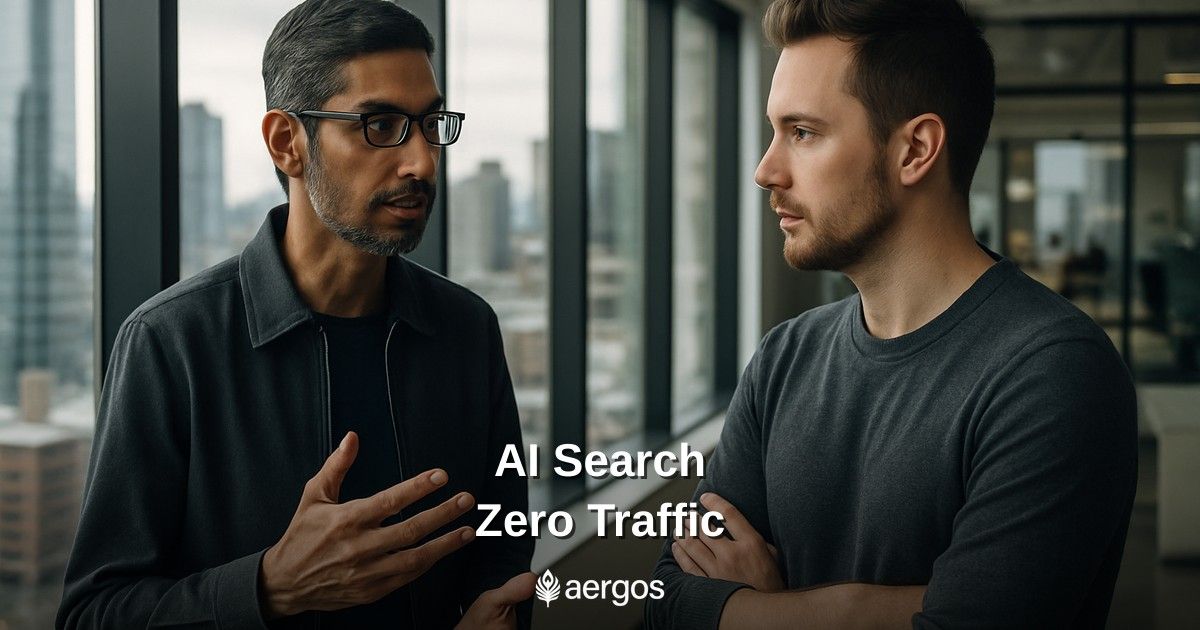
Google CEO Sundar Pichai sat down with Nilay Patel of The Verge just after Google I/O 2026 and gave one of the most candid interviews he has in years. In it, he confirmed that Google is fundamentally rethinking what search does — moving from returning results to triggering actions through its new Gemini Spark agent platform. According to Sundar Pichai on AI, the future of search, and what's happening to the web, the conversation covered Google's internal restructuring in response to ChatGPT, the looming reality of "Google Zero" for publishers, and where Pichai thinks the AI timeline is headed.
This wasn't a polished keynote. It was a fifth-annual sit-down between Patel and Pichai, the kind of conversation where Pichai actually looked at search results on Patel's phone. That matters because you get answers that are less scripted — and some of what Pichai said should be sitting front and center on every agency's radar right now.
The Details: What Pichai Actually Said
The clearest signal from the interview: Google's vision for search is no longer about delivering a list of links. According to Patel's framing in the conversation, the future is the new intelligent search box working together with the Gemini Spark agent platform so that searches can "set off tasks, not just deliver results." Pichai did not push back on that framing.
Pichai also described how he restructured Google internally after the ChatGPT moment. He merged Brain and DeepMind into a single Google DeepMind unit, set up a centralized AI infrastructure team under Amin Vahdat, named Koray Kavukcuoglu as chief AI architect, and consolidated Search leadership under Elizabeth Reid — with Nick Fox overseeing the broader area and Josh Woodward driving Labs and Gemini innovation. He also created weekly AI product reviews that he ran personally, requiring that anything shipping to users involving AI go through that channel.
On YouTube, Pichai acknowledged Google is training its models on YouTube videos and changing YouTube search to summarize content and drop users directly into the relevant parts of a video. Patel noted this is likely to cause creator friction — the same tension Google is already navigating with publishers.
Pichai also confirmed that Google is building what he calls "personal intelligence" — a single effort powered by a common Gemini infrastructure that works across Google products. NotebookLM is one example: the Notebooks feature now appears inside Gemini and syncs between the two products. His point is that for the first time, one model is powering everything.
Google Zero Is No Longer a Theory
Here's the line that should make every publisher and agency owner stop scrolling: Patel coined the term "Google Zero" — the idea that Google traffic to websites would eventually fall to zero as Google answered queries directly — and in this interview noted it has gone from a concept Pichai once batted away to something the CEOs of major media companies like Condé Nast are now openly planning around. Pichai did not dispute that framing.
And yes, this is the part most agencies are still not pricing into their strategies. If even Condé Nast is publicly saying it's planning for zero search traffic, the question isn't whether this is real. The question is what you're doing about it.
The shift from search-as-results to search-as-agent makes this worse, not better. If a search can now trigger a task — booking, summarizing, comparing, buying — then the informational pages that made up the backbone of most SEO strategies become optional stops, not required ones.
What This Means for Your SEO Strategy
Picture this: a user types a query into Google, and instead of getting ten blue links, an agent handles the task end-to-end. No click to your site. No session. No conversion opportunity from organic traffic. That's the direction Pichai described — and it's not a distant future. It's the architecture they're actively building.
The YouTube changes deserve separate attention. If Google is now summarizing video content and indexing it so users can jump to specific timestamps, the value of a video view changes dramatically for creators. Long-form content may still win — but not because users watch it start to finish. Because it gets cited and surfaced in pieces. That's a content strategy shift, not a minor format tweak.
For brands and agencies, the honest read here is this: organic search traffic as a primary channel is under structural pressure. Channels you own — email, community, direct relationships — matter more than they did two years ago. And your content needs to be the kind of thing AI models want to cite, not just the kind of thing that ranks.
That last point is where AI search visibility and E-E-A-T comes in. Getting cited in AI Overviews, Perplexity, and Google's Gemini-driven answers requires a different kind of content than what got you to page one in 2021. It requires demonstrable expertise, clear authorship, and content that directly answers discrete questions — not 2,000-word pillar pages padded for word count.
What to Do Now
- Audit your traffic sources today. If organic search makes up more than 60% of your site's traffic, you are overexposed. Start building out email, direct, and referral channels now — not after the next core update hits.
- Identify which pages on your site are purely informational with no conversion path. These are the most exposed to Google Zero. Either add a real reason for users to engage or consolidate them into pages that serve a clearer purpose.
- Optimize for AI citation, not just ranking. That means clear headings, direct answers early in the content, named authors with real credentials, and schema markup that signals who wrote it and why they're qualified.
- Take YouTube seriously as a search asset. If Google is now indexing video content and dropping users into specific timestamps, your video content needs proper structure — chapters, transcripts, and clear topic segmentation — not just good production quality.
- Watch the Gemini Spark agent platform closely. As agentic search rolls out, the queries most likely to vanish from traditional organic are transactional ones. Review your keyword strategy and flag which terms are at highest risk of being handled entirely by an agent.
Background and Context: How We Got Here
The ChatGPT launch in late 2022 was a genuine inflection point — not just for the AI industry but for how Google thought about its own pace. Pichai described it clearly in this interview: he realized the Overton window had shifted, users were adopting AI tools faster than expected, and Google needed to reorganize to move at the speed the moment required.
Google had spent years building toward AI-assisted search. But the organizational structure was distributed — research split across Brain and DeepMind, Search split across multiple leaders, infrastructure fragmented. The restructuring Pichai describes is his answer to that: consolidate the technology layer, centralize the decision process, and ship faster.
From an SEO standpoint, we've watched this play out in waves. AI Overviews launched in Search. Featured snippets expanded. Zero-click searches climbed. The pattern is consistent: Google captures more of the query-answer loop on its own properties. The Gemini Spark agent integration is the next chapter of that same story — a bigger, more capable chapter.
Demis Hassabis, CEO of Google DeepMind, ended the I/O keynote by saying we are "in the foothills of the singularity," according to the Patel interview. Pichai agreed with that framing. Whatever you think about AGI timelines, the practical signal is that Google is not slowing down. The pace of change in search over the next two to three years is likely to be faster than the last five.
If you want to track how these changes are hitting your own rankings and visibility in real time, Aergos gives you the reporting layer to see what's moving and why — useful when the ground is shifting this fast.
Frequently Asked Questions
Related Articles



Glossary terms in this article
Brush up on the definitions.
In-depth content typically exceeding 1,500 words that provides comprehensive coverage of a topic, tending to earn more links and rank better.
The planning, development, and management of content to achieve specific business goals across all channels and formats.
Visitors who arrive at a website by clicking unpaid search engine results — the primary output metric of SEO programmes.
Unpaid search engine traffic earned through SEO, appearing in natural SERP listings rather than paid advertising positions.
Structured data code added to a page's HTML that helps search engines understand its content and enables rich results in SERPs.
Search experiences powered by large language models that generate conversational answers, synthesize information from multiple sources, and reduce reliance on traditional blue-link SERPs.
About Matt Weitzman
Senior SEO Strategist & Co-Founder
Matt has over 15 years of experience in technical SEO and digital marketing. He specializes in algorithmic recovery, enterprise architecture, and leveraging AI for content scaling. He is a frequent speaker at search marketing conferences.
More articles by Matt Weitzman