OpenAI's GPT-Live-1 Brings Smarter, Less Interruptive Voice Mode to ChatGPT

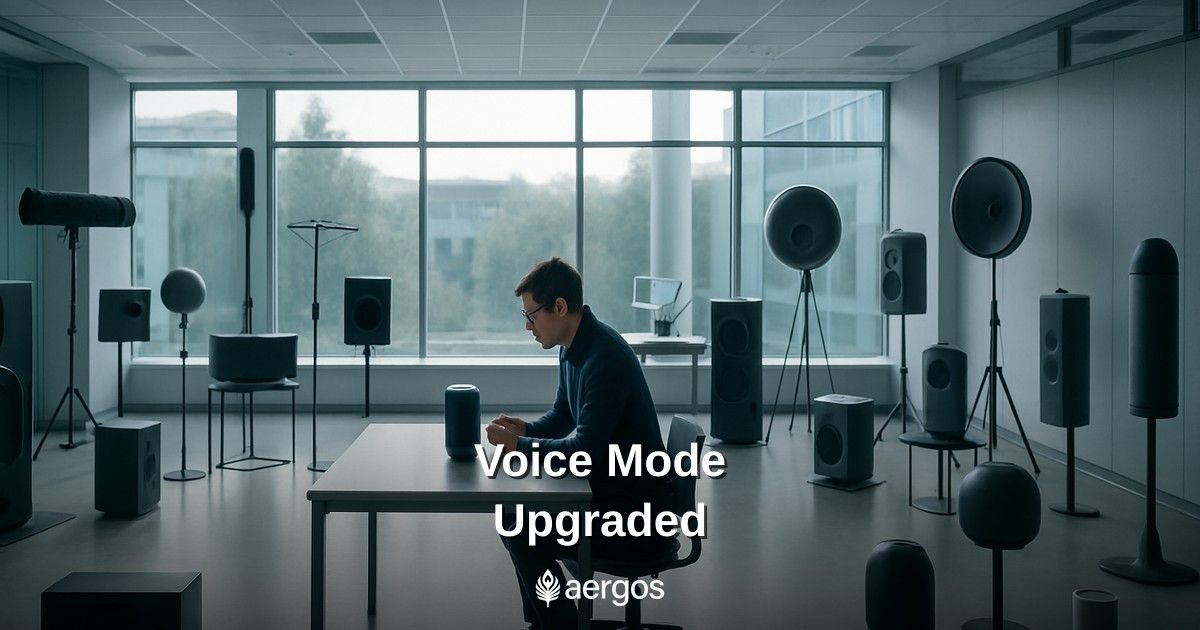
OpenAI launched a major overhaul of ChatGPT's voice mode on July 8, 2026, replacing its older turn-based system with a new model it's calling GPT-Live-1. According to ChatGPT's upgraded voice mode is better at shutting up, the company says the new model is designed to feel more like "talking to another person" — interrupting users less and waiting patiently when someone pauses mid-sentence.
During a press briefing, OpenAI research lead Kundan Kumar called GPT-Live-1 the company's "smartest voice model" yet. That's a meaningful claim from a team that has shipped several voice iterations. The question worth asking: does the tech actually back it up?
What's New With GPT-Live-1
The headline feature is full-duplex audio. OpenAI product lead Atty Eleti explained it during the briefing: "It can speak and listen at the same time. From the model side, it can process the stream of inputs and produce the stream of output continuously and simultaneously." That's a significant technical shift from the old turn-based model, which had to wait for you to stop talking before it could respond.
The practical difference for users is real. The previous voice mode sometimes struggled with natural conversational flow and didn't always produce accurate answers. GPT-Live-1 addresses this partly by offloading heavy lifting to text models. When it needs to reason or search the web, it automatically passes the query to models like GPT-5.5, then transitions back to spoken conversation once it has an answer.
There are several other notable additions baked into the upgrade:
- Real-time translation: ChatGPT can now translate speech while you're still talking, rather than waiting until you finish a sentence.
- On-demand silence: You can now tell ChatGPT Voice to stop talking until called upon, which OpenAI says wasn't possible with the previous model.
- Active listening cues: The model will acknowledge it's listening with phrases like "mhmm", "yeah", and "got it."
- AI-generated visuals: For topics like weather, stocks, and sports, GPT-Live-1 will supplement conversations with visual displays of relevant data — think sports scores or a weekly forecast.
- Built-in safeguards: OpenAI says the model steers away from harmful responses and can end chats entirely in "higher-risk" situations. It's also trained to offer expert-vetted crisis helpline support in self-harm conversations and to provide age-appropriate responses for teens.
Who Gets What
GPT-Live-1 is rolling out across iOS, Android, and web. ChatGPT Go, Plus, and Pro subscribers get the full GPT-Live-1 model. Free users get GPT-Live-1 mini, a smaller and more efficient version that will be the default for that tier.
Why This Matters for Marketers and Content Strategists
Voice search has been "the next big thing" for so long that most SEOs stopped holding their breath. But a genuinely conversational AI voice interface that can reason, search, and respond fluidly changes the game in ways keyword-matching voice assistants never did. This isn't someone saying "Hey Siri, what's the weather." This is a model that can hold a real back-and-forth, pull from web results mid-conversation, and present visual data alongside spoken answers.
That's a different kind of search behavior entirely. If GPT-Live-1 is calling on GPT-5.5 to search the web and then surfacing spoken answers, the question for anyone doing SEO or content strategy becomes: what does my content look like when it's not read, but cited in speech? Is it structured in a way that makes it easy for a model to extract a clean, attributable answer? This is exactly the AI visibility problem that the industry has been wrestling with since AI Overviews launched.
I've been watching this shift unfold at conferences like SMX and BrightonSEO over the past two years. The pattern is consistent: brands that optimize for clear, authoritative, well-structured answers tend to get cited more often across AI surfaces — whether that's a written overview, a chatbot response, or increasingly, a voice reply. The format may shift. The underlying principle doesn't.
For agencies, this also matters from a client education standpoint. Clients are going to start asking why their traffic looks different as voice and AI interactions grow. You need to be able to explain what's happening and show the data. AI visibility tracking is becoming less of a nice-to-have and more of a reporting baseline.
What to Do Now
You don't need to overhaul your content strategy overnight. But a few targeted moves now will put you ahead of the curve as conversational AI matures.
- Audit your most valuable pages for answer clarity. Can a model extract a clean, direct answer from your content in one or two sentences? If not, add a summary or FAQ section that makes that easier. This helps with AI Overviews, ChatGPT citations, and Perplexity alike.
- Check your structured data. Schema markup for FAQs, how-tos, and speakable content is more important now than ever. A model that can speak and listen simultaneously is also a model that's consuming and serving structured information in new ways.
- Think about conversational intent. Voice search queries are longer and more natural in phrasing than text queries. Review your keyword targeting to include question-based and conversational long-tail variants.
- Monitor your brand's AI citation footprint. If ChatGPT is searching the web and surfacing spoken answers, you need to know whether your brand is being mentioned — and how. Start tracking this now, not after your competitors do.
- Educate your clients proactively. Show them what AI-driven answers look like for their core topics. If a competitor is being cited and they aren't, that's a gap with a strategy behind it.
Background and Context
OpenAI's older ChatGPT voice mode was a step forward when it launched but had obvious friction. The turn-based model interrupted users, sometimes gave inaccurate answers, and felt more like a demo than a daily tool. GPT-Live-1 is a genuine architectural improvement, moving from sequential processing to a simultaneous input-output model.
This launch sits inside a broader race between the major AI labs to own the conversational interface. Google has been building Live mode into Gemini. Apple Intelligence is threading AI into Siri. The difference with OpenAI's approach here is the explicit tie-in to its most capable text models — routing voice queries through GPT-5.5 for reasoning and web search gives GPT-Live-1 a quality floor that pure voice-native models haven't had.
OpenAI is also navigating real reputational pressure. The company is currently facing lawsuits alleging ChatGPT has fueled delusions and harmed the mental health of users, according to The Verge's reporting. The built-in safeguards and crisis support features in GPT-Live-1 appear to be a direct response to that scrutiny. How effective those guardrails prove in practice is something the industry will be watching closely.
If you want a quick read on how your site is currently positioned for AI-driven discovery, Aergos has a free AI visibility checker worth running before your next client check-in.
Frequently Asked Questions
Related Articles


Glossary terms in this article
Brush up on the definitions.
The planning, development, and management of content to achieve specific business goals across all channels and formats.
A standardised format for providing information about a page and classifying its content so search engines can better understand it.
The extent to which a brand's content is referenced, cited, or surfaced in AI-generated answers from tools like ChatGPT, Gemini, and Perplexity.
Structured data code added to a page's HTML that helps search engines understand its content and enables rich results in SERPs.
The AI research company behind GPT-4, ChatGPT, and the DALL-E image generation models that have defined the modern generative AI era.
Generative Pre-trained Transformer — OpenAI's family of large language models that power ChatGPT and many AI marketing tools.
About Matt Weitzman
Senior SEO Strategist & Co-Founder
Matt has over 15 years of experience in technical SEO and digital marketing. He specializes in algorithmic recovery, enterprise architecture, and leveraging AI for content scaling. He is a frequent speaker at search marketing conferences.
More articles by Matt Weitzman