GEO vs SEO: What's Actually Different (and Why You Need Both in 2026)

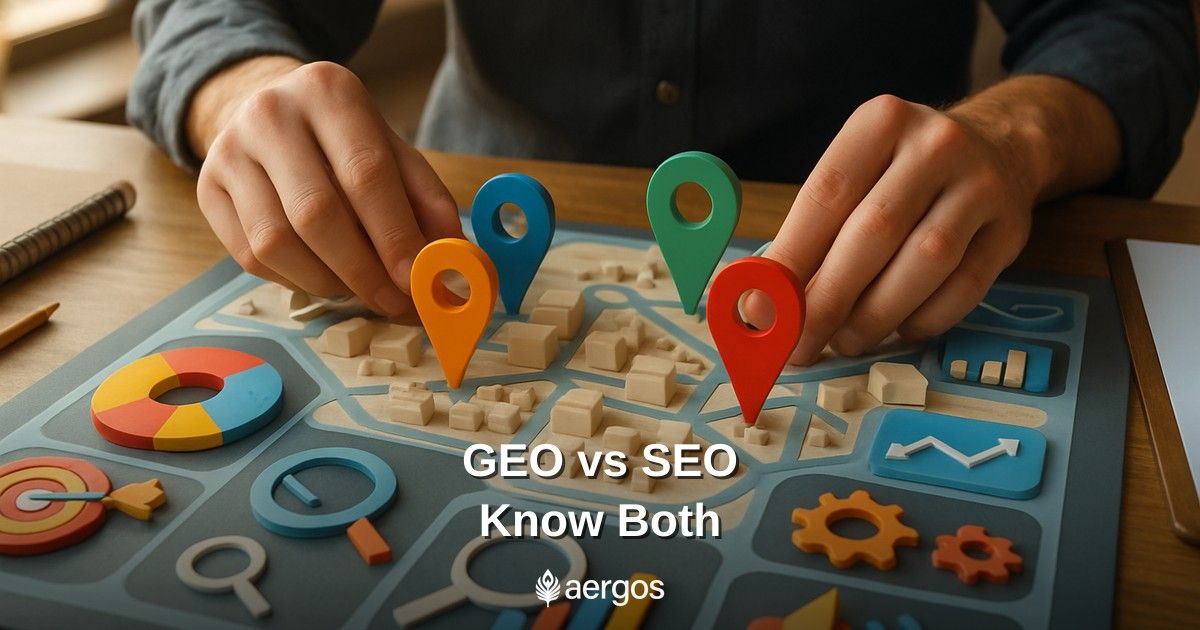
Picture this: you search for the best project management tools for small teams, and the AI Overview at the top of the page names three brands confidently. None of them are yours. Your site ranks on page one. You have the backlinks. You did the work. But the AI didn't cite you. That gap, right there, is the difference between SEO and GEO, and it's why the geo vs seo conversation is one of the most important ones happening in search marketing right now.
This isn't about ditching SEO. Far from it. But if you're running a strategy built only for traditional rankings, you're already leaving visibility on the table. Let's break down what's shared, where the paths diverge, and how to build a strategy that works for both.
Start Here: What Each Term Actually Means
SEO, search engine optimization, is the practice of earning higher rankings in traditional search results. You optimize a page, earn authority, get clicks. It's been the foundation of digital marketing for two decades and it still drives massive traffic.
GEO, or Generative Engine Optimization, is newer and distinct. It's the practice of making your content, brand, and entity citable by AI engines like ChatGPT, Perplexity, Google's AI Overviews, Gemini, and Claude. You're not trying to rank a page. You're trying to be the source an AI pulls from when it synthesizes an answer. If you want the full breakdown of what GEO means and why it emerged, the Generative Engine Optimization explainer covers the full origin story.
The distinction matters because the success metric is totally different. SEO measures clicks and rankings. GEO measures citation frequency, brand mentions inside AI-generated answers, and presence in AI-driven discovery. You can win SEO and lose GEO at the same time. That's not a hypothetical anymore.
The Shared Foundation (Don't Skip This Part)
Before we get into the differences, let's be honest about what SEO and GEO have in common. Skipping this is how people end up building parallel strategies that waste budget and confuse teams.
Crawlability and Access
If a bot can't read your content, neither Googlebot nor GPTBot will use it. Technical accessibility is foundational to both disciplines. That means clean crawl paths, fast server responses, no accidental bot-blocking in your robots.txt, and JavaScript rendered in a way that exposes your core content to crawlers. AI crawlers like GPTBot, ClaudeBot, PerplexityBot, and Google-Extended all need open access to your content to train on it or retrieve it in real time.
Content Quality and Depth
Thin, vague content fails in both environments. Google's helpful content guidelines and AI retrieval models both reward substance. If your content doesn't actually explain something well, it won't rank and it won't get cited. I've watched teams treat GEO like a separate content track and end up with two half-decent content programs instead of one excellent one. Build for depth first.
Entity Clarity
Both Google and AI models use entity-based understanding. Your brand, your authors, your topics — these need to be clearly defined and consistently referenced across your site and the broader web. Schema markup, author bios, About pages, Wikipedia presence, and third-party mentions all feed into how well an entity is understood. This is a shared signal that powers both SEO and GEO.
Where GEO and SEO Actually Diverge
Here's where it gets genuinely interesting. Same foundation, very different execution past a certain point.
Documents vs Passages
Traditional SEO is largely document-level. You optimize a page to rank. The title tag, the H1, the internal links, the domain authority — all of that is evaluated at the page level. Google might surface a passage within the page, but you're still thinking about the URL as the unit.
GEO operates at the passage level. AI models don't retrieve pages, they retrieve chunks. A paragraph that directly answers a specific question, a clearly labeled definition, a concise how-to sequence. If that chunk isn't retrievable, well-formatted, and self-contained enough to make sense pulled from its context, the AI skips it. This means your content architecture has to work at the sentence and paragraph level, not just the page level. That's a real structural shift.
Backlinks vs Entity Authority
Link equity is the backbone of SEO. A strong backlink profile tells Google that other authoritative sites vouch for your content. That signal is real and it still matters in 2026.
For GEO, the equivalent is entity authority — how well-known and well-trusted your brand is across the information ecosystem. That means third-party mentions on credible sites, quotes from named authors, consistent presence in niche communities, citations in industry roundups, and reviews on platforms AI models have been trained on or actively retrieve from. A site with modest backlinks but strong entity recognition can get cited by AI more reliably than a link-heavy site that nobody talks about. I've seen this play out repeatedly in competitive niches.
Ranking vs Citation
This is the most fundamental difference. SEO wins look like: position one, featured snippet, top three in a SERP. You can see them, track them, screenshot them for the client deck.
GEO wins look like: your brand name appearing inside a generated answer. Your statistic being referenced without a link. Your framework being named as a recommended approach. These wins are harder to track, often don't come with a direct click, and require different tooling to even detect. That's part of why GEO is still being underestimated. The attribution gap makes it feel invisible. But invisible isn't the same as unimportant.
Real-Time Retrieval vs Training Data
Some AI engines, like Perplexity and the live web-retrieval mode in ChatGPT, pull content in real time. Others rely primarily on training data with periodic updates. This means GEO has two different time horizons you have to think about. For real-time retrieval, fresh content and live crawlability matter. For training data, longstanding presence and consistent authority on a topic compound over time.
SEO is almost entirely real-time and reactive. GEO requires you to think in both timeframes simultaneously. That's a different kind of editorial planning.
Formatting Signals
In SEO, formatting helps readability and can influence featured snippets. In GEO, formatting is a retrieval signal. Clear H2 and H3 structure, direct definitions at the top of a section, FAQ schema, concise numbered steps, and summary sentences at the start of a passage all increase the likelihood that a chunk gets pulled into an AI-generated answer.
Think of it this way: if a paragraph can't stand alone as a useful answer out of context, it's not GEO-ready. Every key section of your content should be able to answer a question by itself. That's a formatting discipline most content teams haven't had to think about before.
Why You Can't Just Pick One
I get why people ask whether they should focus on SEO or GEO. Budget is finite. Attention is finite. But framing it as a choice is the wrong model.
Search and AI discovery are converging, not competing. Google's Search Generative Experience overview is being integrated into standard search in ways that mean your SERP visibility and your AI citation rate are increasingly tied to the same content and same entity signals. Abandoning traditional SEO to chase GEO would be like tearing out your house foundation to renovate the kitchen.
What you actually need is a layered strategy. SEO handles the document-level game: rankings, clicks, on-page authority. GEO handles the passage-level and entity-level game: citations, brand recognition in generated answers, presence in AI-driven discovery flows. They use some of the same inputs and produce different kinds of output. Build both.
Our full 2026 guide to ranking in both SEO and AI search goes deep on how to structure that layered approach across content, technical, and off-page. Worth reading alongside this one.
The Practical Overlap: What to Optimize for Both
Say you're revamping your content program. Here's what you'd optimize if you wanted it to serve both SEO and GEO at the same time.
- Schema markup — FAQ, HowTo, Article, and Organization schema help both Google's featured snippets and AI passage retrieval
- Named author bios with credentials — Google E-E-A-T and AI entity trust both want to know who wrote something and why they're qualified
- Concise, self-contained definitions — lead each section with a clear answer to the implied question, before adding nuance
- Consistent brand entity signals — keep your brand name, descriptions, and categories consistent across your site, your Google Business Profile, social profiles, and third-party references
- Structured headers — H2s and H3s that mirror real questions people ask, not just keyword-stuffed phrases
- Open crawler access — don't block GPTBot, ClaudeBot, or PerplexityBot in your robots.txt unless you have a deliberate reason to
- Third-party mentions — pursue digital PR, niche community contributions, and expert quotes that build entity authority across the web, not just backlinks
What GEO Requires That SEO Doesn't
And yes, there are things you'll invest in specifically for GEO that don't move the needle much for traditional rankings. This is where the two disciplines split most sharply.
- Passage-level content audits — reviewing whether individual paragraphs are self-contained and answer-worthy, not just whether pages are optimized
- Entity monitoring — tracking where and how your brand is mentioned in AI-generated answers, using tools built for that purpose
- Training data presence — earning mentions on the kinds of high-authority, frequently-crawled sources that AI models weight heavily (Wikipedia, major industry publications, authoritative Q&A sites)
- Answer-first writing structure — leading with the direct answer before the explanation, in every section, at a level that goes beyond what typical SEO content requires
- Citation-worthy original data — publishing original research, surveys, or proprietary data that other sites and AI models have reason to reference
Where to Start: A Practical First Move
If you're newer to GEO but solid on SEO, don't blow up your existing program. Start with a passage audit on your ten highest-traffic pages. Ask one question for each major section: can this paragraph answer a question by itself, clearly and completely? If the answer is no, rewrite the section lead so it can.
Then check your robots.txt. Make sure you're not accidentally blocking AI crawlers. It happens more than most teams realize, especially on sites that have added bot-blocking rules over the years without regular audits.
Next, run a quick entity audit. Search your brand name in Perplexity and ChatGPT. What do they say about you? What do they get wrong? What's missing? That gap between reality and what AI models currently say about your brand is your GEO roadmap.
Track your progress at both layers. Traditional rank tracking tells you how SEO is moving. AI brand mention monitoring tells you how GEO is moving. If you're using Aergos for SEO and AI visibility tracking, you can watch both signals in one place without bouncing between tools.
SEO and GEO aren't rivals. They're layers of the same visibility strategy. The brands that win the next five years are the ones that understand how the two work together — and build for both at once.
Frequently Asked Questions
Related Articles


Glossary terms in this article
Brush up on the definitions.
Google's experimental AI-powered search feature (now AI Overviews) that generates a conversational summary at the top of search results.
The practice of improving a website's visibility in organic search engine results to drive qualified traffic.
Google's free business listing tool that manages how a business appears in Google Search and Maps, including the Local Pack.
All marketing activities that use digital channels — search, social, email, display, content, and AI — to reach, engage, and convert target audiences.
A highlighted search result appearing above organic listings that directly answers a query, pulled from a page's content.
Moz's proprietary 1–100 score predicting how likely a domain is to rank in search engine results, based on its link profile.
About Matt Weitzman
Senior SEO Strategist & Co-Founder
Matt has over 15 years of experience in technical SEO and digital marketing. He specializes in algorithmic recovery, enterprise architecture, and leveraging AI for content scaling. He is a frequent speaker at search marketing conferences.
More articles by Matt Weitzman